|
|
Welcome to ourMonthly Newsletter
We’re excited to share the work happening at the Athens-Clarke County Sustainability Department! Join us each month as we explore all things sustainability and how you can get involved.
In this newsletter, you will find:
latest project, free resources, and upcoming events
|
|
|
|
Artificial IntelligenceWhat does AI mean for sustainability?Part I of IIIOver the next few newsletters, we’ll explore the intersection of artificial intelligence and sustainability: examining the environmental impacts of AI and data centers, the immediate implications for Athens, and practical steps we can take to use AI more responsibly.
AI and Sustainability
Artificial Intelligence (AI) has become an integral part of modern life. It’s unavoidable, useful, powerful, and, at times, controversial. Its rapid adoption is evident - ChatGPT, for example, is now estimated to be the fifth-most visited website globally, just behind Instagram.
The Energy Behind Intelligence
AI systems do not emerge fully formed; they require extensive “training” before they can generate answers. This process is both time-consuming and resource-intensive. Training OpenAI’s GPT-4, for instance, is estimated to have cost over $100 million and consumed approximately 50 gigawatt-hours of energy. That’s enough to power the entire city of San Francisco for three days! As AI models grow in complexity, these demands scale dramatically.
The Hidden Cost of Every Query
While each AI query may seem negligible in isolation (ranging from 0.03 Wh to 1.8 Wh for text and even more for images) the sheer volume of interactions compounds the impact. In December 2024, OpenAI reported that ChatGPT handled 1 billion messages per day, and by March 2025, users were generating 78 million images daily. Over a year, this activity could require more than 109 gigawatt-hours of electricity, enough to power 10,400 U.S. homes, with image generation adding another 35 gigawatt-hours.
Water, Carbon, and E-Waste
The environmental footprint of AI extends beyond electricity. Cooling the servers that power AI models requires significant water resources. Research suggests that AI server deployment across the United States could generate an annual water footprint of 731 to 1,125 million cubic meters, alongside 24 to 44 million metric tons of CO₂-equivalent emissions between 2024 and 2030.
Carbon emissions are another pressing concern. By 2030–2035, data centers could account for 20% of global electricity use, placing immense strain on power grids. AI-specific workloads alone are projected to consume 165 to 326 terawatt-hours per year by 2028. This level of consumption could generate emissions equivalent to driving 300 billion miles, or over 1,600 round trips to the sun.
Hardware turnover adds yet another layer of impact. Studies indicate that AI-related e-waste could accumulate to 1.2–5.0 million tons between 2020 and 2030, depending on growth scenarios.
In our next newsletter, we’ll dive deeper into the data centers that power these AI models; their rapid growth across the U.S., and what that could mean for Athens.
For Sources, Click Here |
|
|
|
|
|
This Month's Topic:Sustainable DietBy Riley JamesFor most people, January is the month of self-improvement. Gym memberships spike, planners fly off shelves, and suddenly everyone is blending kale like it’s a competitive sport. But what if your resolution could do more than boost your health? What if it could help the planet too? Enter the sustainable diet. According to the Food and Agriculture Organization (FAO), sustainable diets are eating patterns that promote health and well-being while minimizing environmental impact; all without sacrificing cultural traditions or affordability. Sounds great! But we have to remember that sustainability isn’t just about the environment. It’s about balance, accessibility, and nutrition. |
|
|
|
|
|
On paper, some foods that look “planet-friendly” aren’t necessarily good for you. Take sugar, for example. From an environmental perspective, it’s practically a hero: low land use, low water demand, and minimal greenhouse gas emissions. But nutritionally, it’s more of a zero. That’s why sustainable eating means looking at the whole picture: foods that are good for the planet and good for your body. Because a diet that saves the Earth but wrecks your health isn’t really sustainable. Here are five easy ways to eat better for yourself and the Earth: - Eat More Plants
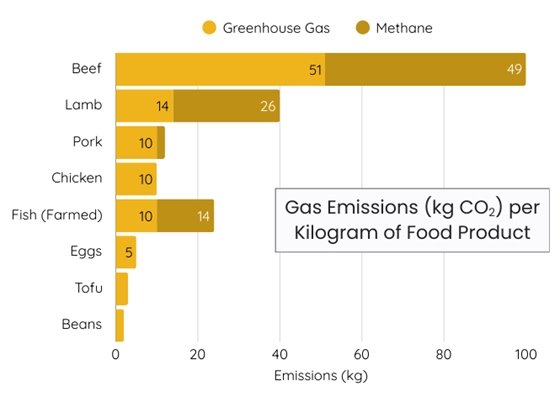
Plants are the MVP of sustainable eating. Beef has a carbon footprint of 36 kg of CO₂ per kilogram, nearly four times that of chicken and up to 100 times higher than most plant-based foods. Even swapping one beef meal for a plant-based option makes a big difference. - Mix It Up
Variety isn’t just the spice of life — it’s the backbone of biodiversity. Today, 90% of our food energy comes from only 15 plant species, which is bad news for ecosystems and nutrition. Try new grains, veggies, and legumes to keep your meals interesting and the planet resilient. - Shop Local
Support local farmers and cut down on transportation emissions. Athens has great options: Bishop Park Farmers Market every Saturday year-round, and Creature Comforts Market on Wednesdays (March–November). - Eat Less Meat
You don’t have to go full vegan to make an impact. Even reducing meat intake helps. Choosing chicken over beef for one meal can cut emissions equivalent to driving 9 miles in a car. - Reduce & Compost Food Waste
Plan meals, buy only what you need, and compost scraps. Athens-Clarke County offers a Food Scraps Drop-Off Program — check it out here.
Sustainable eating isn’t about perfection — it’s about progress. Start with one change, stick with it, and let your plate reflect the kind of future you want to see. For sources, click here! |
|
|
|
Powering SustainabilityBy Tishia McRaeInvesting in the future of Athens-Clarke County
When you see a new sustainability program, workshop, or community event, you might wonder: How does this happen?
Our work is rarely funded by just one source. Instead, it’s made possible through a combination of local investment, voter-approved funding, and partnerships with regional and state organizations.
One key funding source is SPLOST (Special Purpose Local Option Sales Tax), which allows the community to invest directly in infrastructure and long-term improvements that support efficiency, resilience, and quality of life. These voter-approved funds help lay the groundwork for sustainability projects that benefit the entire community.
Another important tool is the Community Energy Fund, which supports initiatives focused on clean energy, energy education, and reducing energy costs for residents. By reinvesting funds locally, the Community Energy Fund helps ensure that sustainability efforts remain accessible and community-centered.
In addition to local funding, Athens-Clarke County actively pursues grants and collaborative funding opportunities. These funds range from federal, state, and philanthropic sources and allow us to pilot new ideas, expand successful programs, and bring additional resources into the community without increasing local taxes.
Collaboration is essential to making this work successful. The Sustainability Department is currently partnering with Clean Cities Georgia, Georgia Department of Natural Resources, Georgia Rivers, and local partners like UOWN, University of Georgia, and Athens Tech. We are members of the Southeastern Sustainability Directors Network, and these partnerships make sure we stay on the cutting edge by connecting expertise, education, workforce development, and environmental stewardship to ensure that sustainability efforts reflect both local needs and regional best practices.
This multi-faceted approach allows Athens-Clarke County to turn long-term sustainability goals into real, visible progress. From education and outreach to on-the-ground projects we are committed to supporting a healthier, more resilient community.
|
|
|
|
|
|
The Comfort of Crows: A Backyard YearBy Margaret RenklI've always been drawn to phenology wheels and beautifully colored temperature quilts, there's just something about recording data in both visual and artistic ways that just makes sense to my brain. It’s the coupling of the scientific with the artistic that both calms and enlivens. What makes them seem doable is the commonplace data they record. In her book The Comfort of Crows: A Backyard Year, Margaret Renkl walks you around a phenology wheel of her observations from "the land of the common". The thing is that her writing makes every crow, leaf, or mangy suburban fox all seem uncommon and worthy of careful consideration- and ultimately leaves you wondering just what type of commonplace wonders are happening outside your very own door and how to best appreciate their "un-rarity". The book is a collection of short essays and poems describing what she observes in her backyard, neighborhood, and general "home range". While you could sit down and read its entirety in a night or two- I dare you to read it just as its staged, one week at a time, meandering your way through the seasons. Then after each chapter head outside and see all the common natural happenings you've let pass unobserved here in Athens and maybe add them to your very own phenology wheel or mental calendar. Recommended by Stephanie Green
|
|
|
|
Did you know?You can report a street light outageEasily report street light issues or outages through Georgia Power’s website. The tool is available to everyone and provides real-time updates on the repair status, so you’ll know when the light is fixed. Access the tool, here! |
|
|
|
Upcoming Events:********************************************************Clean & Renewable Energy Plan Study GroupGoing on now! Dive into Athens-Clarke County’s Clean & Renewable Energy Plan in a supportive, discussion-based study group. Over four weeks, we’ll review key goals, strategies, and local opportunities for clean & renewable action. When: Wednesdays, January 7 - 28, 2026 Where: Covenant Presbyterian Church 1065 Gaines School Road, Athens, GA 30605 Questions: info@sosuin.org RSVP Here!
********************************************************Bring Back Your Backyard: Invasive Removal 101Learning about local invasive species and how to remove them. When: 10:00AM, Saturday, January 10, 2026 Where: Ben Burton Park 616 Mitchell Bridge Rd, Athens, GA 30606 More info, here!
********************************************************MLK Day of ServiceVolunteer registration is now open! Athenians are invited to honor Dr. King's legacy at the annual Athens-Clarke County Martin Luther King Jr. Day of Service on Monday, January 19, 2026. When: Saturday, January 19, 2026 Questions: athensgamlkday@gmail.com More info, here!
********************************************************Bring One For The ChipperGoing on now! Christmas Tree drop sites: - ACC Landfill
- CHaRM
- GA Square Mall
- Lexington Road Tag Office
When: Until January 15, 2026 More info, here! |
|
|
|
Athens- Clarke County Sustainability Departmentwww.accgov.com/green 706-613-3838 Putting Energy Into Greener Spaces |
|
|
|
|
|




 Share on Facebook
 Share on Twitter
 Share via Email
