|
|
Welcome to our Monthly Newsletter!Welcome to the twelfth issue of our monthly newsletter! We are thrilled be able to share what we are doing at the Athens-Clarke County Sustainability Department with you. Join us each month as we explore all things sustainability and how you can get involved! In this newsletter you will find: Latest projects, free resources, and upcoming events! |
|
|
|
You're Vote has Power!Hannah Chaffee We’ve been waiting and it’s finally here: for the first time in 5 years, Georgia will be holding a Special Election for the Public Service Commission! The Georgia Public Service Commission (commonly referred to as the PSC) is a state governing body that oversees multiple utility industries. They make decisions on how much clean energy Georgia Power must use, how much Georgia Power can charge costumers for utilities and which costumers have to bear financial loads for expanding energy production. The PSC is made up of one representative from each of the 5 Public Service Commission Districts (see graphic). Terms last 6 years and voting for seats is staggered. Candidates must reside in the district they are running for, but the same rule does not apply to voters. Georgia voters can vote in every PSC district election, regardless of which district they live in. Skip to the next page for important voting dates and guidelines, check out our previous articles covering the basics of the Public Service Commission and what Athens-Clarke County is advocating for in PSC hearings, or continue reading to learn about why this isn’t a normal election. In 2022, a case was filed with a federal district judge challenging this at-large method of electing Commissioners on the grounds that elected Commissioners are not true representatives of their districts as they are selected by all Georgia voters and not exclusively by voters of their districts. The judge ruled that this method unfairly reduced the value of Black voters’ voices, violating the Voting Rights Act of 1965. This ruling was eventually overturned, but during the lengthy litigation Georgia Secretary of State Brad Raffensperger cancelled the 2022 and 2024 Pubic Service Commission elections (for District 2, 3 and 5). After the pause on elections were lifted, the Georgia legislature passed a bill which extended the terms of current Commissioners and shortened the terms for the next Commissioners elected to District 2 and 3. This bill outlined that District 2 and District 3 elections would be postponed to 2025, District 5 elections to 2026 and District 1 and 4 election to 2028. PSC Commissioners:- District 1: Jason Shaw, PSC Chairman
- District 2: Tim Echols, Vice-Chairman (Seat up for election)
- District 3: Fits Johnson (Seat up for election)
- District 4: Lauren "Bubba" McDonald
- District 5: Tricia Pridemore
The PSC Regulates:- Electricity
- Natural Gas
- Telecoms
- Underground Facilities
For sources click here! Make Your Voice Heard!GEORGIA PUBLIC SERVICE COMMISSIONER ELECTION FOR DISTRICTS 2 & 3Special Primary: June 17th 2025(If needed) Special Primary Runoff: July 15th 2025Special Election: November 4th 2025 (If needed) Special Election Runoff: December 2nd 2025
Register to VoteAre you registered to vote? If this will be your first time voting you will have to register to vote. You only have to register to vote once, however if you have moved, you may have to update your voter registration. To do so or to register to vote here! Last Day to Register to Vote in the Special Election Primary: Monday May 19th ‘25 Last Day to Register to Vote in Special Election: Monday October 6th ‘25 Early VotingEarly voting takes place Monday through Saturday May 27th through June 13th. Below are the Early Voting locations and hours for Athens-Clarke County. You can vote at any early voting location within your registered county (compared to Election Day voting which requires you to vote in your precinct). You will need to bring a valid photo ID or a voter identification card. Athens-Clarke County Elections Office 155 E. Washington Street Athens GA 30601 Tuesday May 27th-Friday May 30th: 8:00am-5:00pm Saturday May 31st: 9:00am-5:00pm Monday June 2nd -Friday June 6th: 8:00am-5:00pm Saturday June 7th: 9:00am - 5:00pm Monday June 9th -Tuesday June 10th: 8:00am-5:00pm Wednesday June 11th: 8:00am-7:00pm Thursday June 12th -Friday June 13th: 8:00am-5:00pm
Athens-Clarke County Regional Library 2025 Baxter Street Athens GA 30606 Saturday June 7th: 9:00am - 5:00pm Monday June 9th: 8:00am - 5:00pm Tuesday June 10th: 8:00am - 5:00pm Wednesday June 11th: 8:00am - 7:00pm Thursday June 12th: 8:00am - 5:00pm Friday June 13th: 8:00am - 5:00pm
If there is a Special Primary Runoff, early voting for such election will begin as soon as possible and no later than Monday July 7th - Friday July 11th. Advanced voting for the General Special Election will begin as soon as possible and no later than Monday November 24th - Friday November 28th. Learn more about early voting! Absentee VotingTo request an absentee ballot, you’ll need to complete an Absentee Ballot Application. Your application must be received by June 6th to the registrar’s office of the county you are registered to vote in.
Click here for the Georgia Official Absentee Ballot Application! Election Day VotingYou will need a valid photo ID or a voter identification card to vote in person. Polling places are open from 7:00 am to 7:00 pm on Election Day. If you are in line by 7:00 pm, you are allowed to cast your ballot.
Find more information here! |
|
|
|
|
|
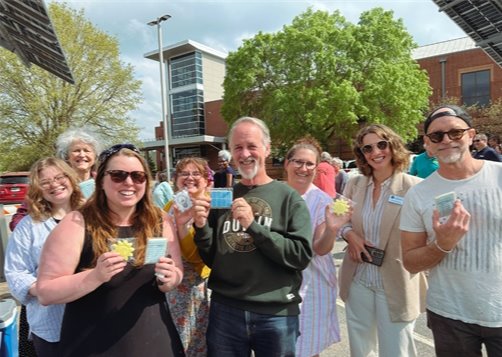 Attendees hold up energy and library themed cookies: sun, solar panel, light bulb, book, and book check out card. Photo Credit: Hannah Chaffee |
|
|
|
One for the BooksAthens-Clarke County Community Celebrates Solar Panels Installed at LibraryHannah Chaffee A small crowd gathered in front of the Athens-Clarke County Library for the dedication of the newly installed solar panels on April 2nd 2025. The Athens Regional Library System serves over 240,000 residents across five counties, supporting literacy while providing information services, audiovisual materials, along with local history and genealogy resources. Several leaders spoke at the event including Mayor Kelly Girtz, State Librarian and Athens’ resident Julie Walker, newly hired Athens Regional Library System Executive Director Beth McIntyre and ACCGov Sustainability Department Director Mike Wharton who described the installation as “a testament of Athens’ dedication to the next generation” when asked about the project. Funded through a combination of grant and SPLOST 2020 Project 23 and 11 allocations, the 141-Kilowatt system will supply 20% of the library’s annual energy needs or the same as powering 27 homes for an entire year! Library goers will be able to see the solar array’s live energy production on a display screen located at the entrance of the building. This installation will not only move ACCGov closer to our clean and renewable energy goals, but will also save ~$25,000 a year in utility costs. The panels, installed by Solar Sun World, are dual-axis trackers. They rotate both up and down as well as side to side, slowly following the path of the sun throughout the day like giant metallic flowers. This allows the panels to optimize the amount of light they receive. Accompanying the project, a publicly available level 3 fast charger will be installed, directly powered by the panels. This charger, funded separately through SPLOST 2020 Project 11, will be the first level 3 installed by ACCGov. Want to learn more about sustainability and renewable energy? The Athens-Clarke County Library system has a wide array of resources -pun intended! Library Solar- A 141 kilowatt dual-axis solar array's Yearly Impact:- $24,600 Utility Savings
- Providing Renewable Energy to 20% of site power needs
- Produces enough energy to power:
- 27 homes
- Or 1,514 60-watt light bulbs 8 hours per day
- ~106 tons less CO2 emissions per year, equivalent to:
- 10,874 gallons of gasoline
- Or 102,927 lbs of coal use
To learn more about the Athens-Clarke County Library Solar and other renewable energy projects check out our website! |
|
|
|
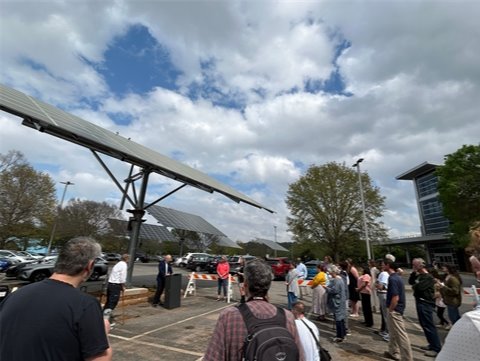 The mayor speaks to crowd at library solar dedication. Photo Credit: Hannah Chaffee |
|
|
|
|
|
 View from solar panels from below Photo Credit: Hannah Chaffee |
|
|
 Photo Credit: Hannah Chaffee |
|
|
 Bottom: Solar panel at Athens-Clarke County Library Photo Credit: Hannah Chaffee |
|
|
|
Tips for a Greener Lifestyle!In this series we explore how we can be sustainable together, right here in Athens-Clarke County! This Month's Topic:Sustainable Flushing With the Water Conservation OfficeKatie Kirkland, Program Education Specialist Water Conservation Office | Public Utilities Department |
|
|
|
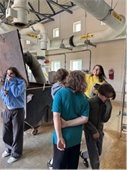 Photo Credit: Audrey Hughes Headworks Smells at the Cedar Creek Water Reclamation Facility |
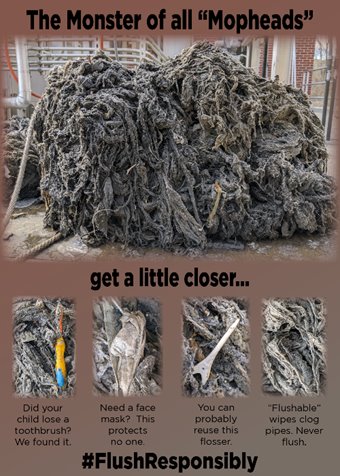
When it comes to sustainable water use at home, people of all ages can share ways to use water wisely, such as not running the water while brushing their teeth and taking shorter showers. However, we would like to offer some tips to help sustain our infrastructure, specifically regarding sewers, and reduce waste. Taking a tour of one of our three water reclamation facilities offers an excellent opportunity to learn about and observe behaviors that can be improved when caring for our sewer system. If you take a look inside headworks, where solids (mostly trash) are removed from the wastewater, you are sure to see certain types of trash. Let me enlighten you about the items we see most frequently and the industry names for some of these unique treasures. You will always encounter condoms (Oconee River Whitefish), tampon applicators (beach whistles), and wipes tangled up (mopheads), along with many other items that do not belong in the sewer. All the trash we screen out of the wastewater will be taken to the landfill, and there is a cost for each load we deliver. Not only can trash damage the machinery we use to clean the wastewater and cause clogs, but as the pounds of trash we send to the landfill increase, so does the cost of our operations. So, what are some solutions to this trashiness? Of course, we promote the 4 Ps of Flushing so that instead of listing everything that shouldn’t be flushed, we can state the only things that should be flushed: Pee, Poo, Paper, and Puke. However, that doesn’t eliminate this trash from existing. Here are some sustainable solutions for our main offenders:
|
|
|
|
COMMON CULPRITS:Period ProductsThere are several options for a zero-waste period that eliminate the possibility of flushing period products down the toilet. Reusable menstrual discs or cups are excellent choices for insertable items. Reusable pads and period underwear are great options for external protection. If these options are not your cup of tea, simply ensure that period products do not enter the sewers by always disposing of them in the trash. “Flushable” Wipes“Flushable” wipes are more durable and can leave a cleaner feeling than toilet paper alone. Consider installing a bidet if it is the clean feeling you are chasing. Several easy-to-install bidet options would cost less than a year’s supply of wipes. If the durability of a wipe is what keeps them in your bathroom, consider experimenting with different septic-safe toilet paper brands. If you don’t want to change the habit of using wipes, change the habit of flushing them. Wipes are detrimental to sewer and septic systems. A dedicated trash can with a lid can provide a more discreet and less fragrant disposal option. |
|
|
|
|
|
CondomsPlease do not stop using these. I’ve got nothing for you to replace this with. All we ask is that you do not flush them. As stated above, having a trash can with a lid can be an option for more discreet and less fragrant disposal.
Thank you for doing your part to keep our sewers happy! If you already follow our 4 Ps of flushing, the best thing you can do is spread the word to others to help us keep our machinery in tiptop shape and lower the costs of visits to the landfill. If you are interested in seeing the wastewater facility for yourself, look out for our quarterly public tours of water facilities or contact me at katie.kirkland@accgov.com. And please stop flushing condoms, I can’t keep telling our Water Reclamation Facility field trips of 3rd graders that they are balloons, they are starting to not believe me! |
|
|
|
Elective PayHannah Chaffee Disclaimer: This article provides general information about tax law for informational purposes only & should not be used as tax guidance. Please consult IRS issued guidance & your professional tax advisor for specific tax advice. No one wants to talk about taxes ...at least not usually! But this past month, Athens-Clarke County hosted a lively roundtable with the Georgia Environmental Finance Authority and the Southeast Energy Efficiency Alliance for several local non-taxable organizations, discussing a relatively new federal tax program: Elective Pay! Also called Direct Pay, this tax program enacted in 2022 allows non-taxable entities like schools, religious groups, non-profits and local governments to receive a percentage of costs back for qualified clean energy related projects. Elective pay is not a grant; there is no competitive process, meaning eligible entities who correctly file for qualifying projects are guaranteed that money back. This monetary return is called a credit. There are no restrictions for how organizations can use their credit once they get it back. There are numerous types of credits that fall under Elective Pay, but it is important not to confuse these for federal residential or commercial tax rebates which have different project requirements despite covering some of the same types of investments. Generally, there are three are three types of investments which qualify for Elective Pay: - Electric/plug-in hybrid vehicles
- Electric vehicle (EV) charging stations
- Solar, ground source heat pumps, and batteries
There is no limit on the number of vehicles, EV chargers, or solar projects an organization can file for. For these credits, organizations file (apply) for all projects put into service the previous year. These means organization can apply year after year for every new project, vehicle or electric vehicle charger. Organizations can choose to file based on either the calendar or fiscal/tax year. Each of these calendar years have different Elective Pay deadlines, but all organizations will follow the same steps.
|
|
|
|
 Elective Pay Round Table Attendees Chat Before Meeting Photo Credit: Laura Iyer, Southern Sustainability Institute |
|
|
|
There are many specific rules and requirements for Elective Pay, so we’ll dive into the basics for each credit below: Energy Investment Credit (48): Solar, Ground Source Heat Pumps and BatteriesThis credit applied for renewable energy or energy storage investments. For projects less than 1 Megawatt, the credit is 30% of project costs and Prevailing Wage and Apprenticeship requirements do not apply. Projects over 1 Megawatt have more requirements. This credit also has several ‘bonuses’ which are applied for through a separate application and add an additional percent of project cost back to the credit. Qualified Commercial Clean Vehicles Credit (45W): Electric or plug-in hybrid vehiclesVehicles must be produced by a qualified manufacturer and purchased for your business’ use and not for resale. Compact plug-in hybrid vehicles with a gross vehicle weight rating (GVWR) less than 14,000 lbs can get up $7,000 per vehicle while other hybrids and full electric vehicles also under 14,000 lbs GVWR can get up to $7,500 back per vehicle. Vehicles over 14,000 lbs GVWR can get up to $40,000 back. Electric/plug-in hybrid vehicles are generally the easiest type of investment to file for through Elective Pay. Alternative Fuel Vehicle Refueling Property Credit (30C): Electric vehicle charging stationsElectric vehicle charging stations must be located in a rural or low-income area eligible census track in order to qualify for Elective Pay. If a charger was placed into service before January 1st 2025, 2015 Census Track Identifier should be used, while those placed into service after should use 2020 Census Track Information. Qualified chargers receive 6% of project costs but if Prevailing Wage and Apprenticeship (PWA) requirements are met for on site installation, a charger receives 30% of project costs. Elective Pay Process1. Identify qualified projects 2. Collect necessary documents/information 3. Complete Pre-Registration through IRS portal 4. Receive unique project identification numbers from IRS 5. E-File or Paper file for Elective Pay 6. Receive money back from federal government These are just an abbreviated and simplified version of Elective Pay requirements. Entities will need to become knowledgeable of the specifics that will affect their qualifications and filing. The Elective Pay process may sound daunting, but there are many organizations dedicated to making that process easier and even more groups who have successfully filed that want to share their insight. Athens-Clarke County recently submitted their 2024 Elective Pay filings for 17 electric vehicles and 22 electric vehicle charging stations and expects to receive approximately $130,000 back from the federal government. ACCGov would not have been able to file for Elective Pay without the assistance of the non-profit Lawyers for Good Government. Lawyers for Good Government has a thorough collection of up to date Elective Pay resources. Local non-taxable entities interested in Elective Pay are encouraged to stay tuned for more resources and reach out to Athens-Clarke County Sustainability Department with any questions. |
|
|
|
Invasive of the Month: Chinaberry TreeChristian Snead Join us each month in this new series as we learn about different invasive species! Have you noticed a tree around town covered with dense clusters of lavender flowers? As lovely as it looks, it’s actually the invasive Chinaberry tree (Melia azedarach). Native to India, and southeast Asia, Chinaberry was first introduced to Georgia in the 1830s as a fast-growing shade tree. Since then, it has escaped cultivation and spread widely, commonly appearing in yards, along roadsides, fence lines, and at the edges of forests and fields. Chinaberry grows up to 50 feet tall and often develops multiple trunks. Its bark becomes rough and deeply grooved with age, while the twigs remain smooth and glossy with tiny pale dots. It has large, compound leaves with dark lance-shaped leaflets that turn golden yellow in the fall. Right now, those clusters of purple blooms may catch your eye—but soon they’ll be replaced by just as many yellow berries. |
|
|
|
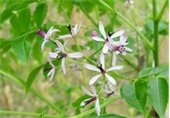 Photo Credit: Chuck Bargeron, University of Georgia, Bugwood |
|
|
 Photo Credit: Franklin Bonner, Bugwood |
|
|
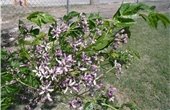 Photo Credit: Karan A. Rawlins, University of Georgia, Bugwood |
|
|
|
Unfortunately, those berries are toxic, especially to people, animals, and some birds. In fact, every part of the Chinaberry tree contains toxins. It also produces chemicals that suppress surrounding vegetation and alters the soil by increasing nitrogen levels, giving it a competitive edge over native plants. Chinaberry’s ability to grow quickly, reproduce both by seed and vegetatively, and thrive in a wide range of conditions makes it a real threat to our local ecosystems. If you find one growing on your property, consider removing it. While small seedlings can be pulled up by hand, larger trees usually require cutting and immediate application of an herbicide like triclopyr to the stump. Be prepared to follow up, as Chinaberry resprouts easily. Now’s a great time to spot and stop this invader before it spreads even further. For sources click here! |
|
|
|
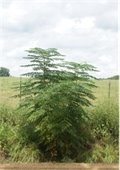 Photo Credit: Chuck Bargeron, University of Georgia, Bugwood |
|
|
 Photo Credit: Chuck Bargeron, University of Georgia, Bugwood |
|
|
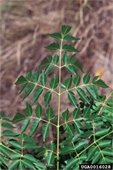 Photo Credit: James H. Miller, USDA Forest Service, Bugwood |
|
|
|
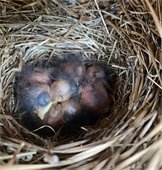 Bluebird Hatchlings approximately 2 days old. Photo Credit: Stephanie Green |
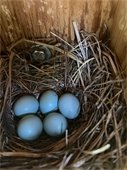
Welcome Athens’ Newest Residents!Stephanie Green These five little Eastern Bluebirds made their debut in the world during Earth Week in April, and a week later- look how they’ve grown! Mom incubated the light blue eggs for about two weeks, while Dad supplied meals and kept a protective watch. They hatched around April 23rd. Thanks to a steady diet of protein rich insects they will grow quickly and take their first leap out of the nest in about 18 days. You may have walked past their temporary home the last time you were at Dudley Park without even realizing it. Their nest box is one of eight placed along the North Oconee River Greenway and within Dudley Park through funding from the Georgia Outdoor Stewardship Program.
|
|
|
|
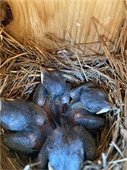 Bluebird hatchlings at one week old. Photo Credits: Stephanie Green |
The nest boxes provide habitat for cavity nesting birds in our urban parks. They might look a little out of place mounted on smooth metal poles and sporting a metal “stove-pipe” guard, but these features deter hungry predators like snakes and racoons. Another thing to note is that the small size of the entrance whole excludes larger birds from using the boxes; successfully blocking Brown-headed cowbirds from parasitizing the nests, or European starlings from taking over. During nesting season, Sustainability staff check the nest boxes weekly and record nesting activity, following the Nest Watch program guidelines (which includes taking the pictures we are sharing with you).
|
|
|
|
Since the boxes were installed in Spring of 2023, they’ve been used by Carolina Chickadees, Carolina Wrens, Northern House Wrens, and Eastern Bluebirds. In 2024, 12 Eastern Bluebirds, 9 Northern House Wrens, and 5 Carolina Chickadees were successfully hatched and fledged from the nest boxes. Through the regular nest checks staff has witnessed some inter-species nesting drama: Chickadees’ nests being taken over by Carolina Wrens who were in turn kicked out by House Wrens. And that’s just at one single nest box! We’ve also learned that once the House Wrens get back in town, they will stuff every box they can with twigs to keep others from using it. Kind of rude, but that’s one way to beat the competition! We hope you enjoy some pictures from past monitoring sessions!
|
|
|
|
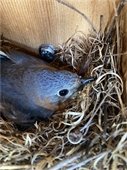 Eastern Bluebird female incubating eggs in a nest box. Bluebirds make their nests out of grass and pine needles with very few twigs. |
|
|
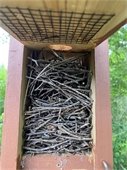 This is a classic example of a Northern House Wren nest. Far inside that pile of sticks is a hollow with eggs. They typically build several nests, but only use one of the finished products. Their “dummy nests” effectively prevent other birds from using the nest boxes. |
|
|
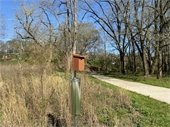 Example of one of the nest boxes placed along the North Oconee River Greenway. Notice the predator guard. The “stove-pipe” style helps prevent snakes from climbing up into the nest box. We also try to keep any branches cut back from over top of the box. |
|
|
|
Congratulations to the 2025 Greenlife Award Winners!This event honors organizations and individuals who go above and beyond in creating a more sustainable tomorrow for us all. Athens Land Trust - Neighborhood Sustainability Partner of the Year: Robert Hampton, R&J Maintenance
- Conservation Leader of the Year: Dyan Holt
- Community Climate Champion: Laura Iyer, Southern Sustainability Institute
- Keys to Success Family Award: Samantha Moore and Family
ACC Transit - Transit Titan: ACC People & Belonging Department
Keep Athens-Clarke County Beautiful - Adopt-A-Highway Group of the Year: Athens Area Democratic Socialists of America
- Keepin' It Clean Community Member of the Year: Nathan Stuck
- Beautiful Business of the Year: Telecom Innovations
Athens Community Tree Council - Community Tree Steward -Organization: Boulevard Neighborhood Association Tree Committee
- Community Tree Steward -Individual: Holly Campbell
ACC Stormwater Management - 2025 Stormwater Steward Award -Residential: Bob Dulinawka
- Stormwater Steward Award -Commercial: SPG Planners + Engineers
UGA State Botanical Garden of Georgia - Garden Earth Naturalist Award: Linda Chafin
Athens-Clarke County Public Utilities - Leadership in Water Conservation: Clarke Middle School Science, Energy & Adventure Team
ACC Waste Reduction Division - Zero Hero of the Year: Audrey Hughes
- Rot Star: UGA Dining Services and UGA Facilities Management Division, Sustainability
Upper Oconee watershed Network - Unsung Hero Award: Dr. Erin Lipp
Athens Rivers Alive - Rivers Alive Supporting Sponsor: Jacobs
Learn more about the Greenlife Awards! |
|
|
|
UPCOMING EVENTS:****************************************************************************************************** International Compost Awareness Week: May 4-10, 2025Celebrated annually, International Compost Awareness Week (ICAW) is designed to promote the benefits of composting and compost itself for effective resource management, soil health, and plant growth. ICAW is promoted by holding group activities and events throughout the week. This year's international poster shows off the Athens skyline from North Avenue. Show off your Athens pride and join in on the activities! The events are sponsored locally by ACC Waste Reduction Division, Keep Athens-Clarke County Beautiful, UGA Cooperative Extension, ACC Library, and the State Botanical Garden of Georgia. For any questions please contact: compost@accgov.com. Check out all the fun events here! ****************************************************************************************************** RAMP UP for Spring Cleaning!Keep Athens-Clarke County BeautifulIt its time for our Loop 10 Daffodil Plantings to burst into bloom and KACCB encourages you to get outside, enjoy the show, and cleanup our roadways for the Great American Cleanup. How You Can Help? Donate to help plant more daffodils on the loop!Consider adopting a road or a ramp! Adopt-A-Highway is a FREE program. A sign, tools and pick up your collected trash are provided.Schedule a One-Time Cleanup. Our Down & Dirty Program is perfect for clubs, churches, classrooms and even individuals and families that need a one-time service project.
For more information or to reserve tools: Email carlos.pinto@accgov.com or call 706-613-3501 x7871 www.keepathensbeautiful.org ****************************************************************************************************** Adopt a Friend: Bald Cypress or White Oak!Keep Athens-Clarke County Beautifulwww.accgov.com/kaccb Contact stacy.smith@accgov.com ****************************************************************************************************** Percentage Night at SurcherosKeep Athens-Clarke County BeautifulMay 6th 5:00 pm to 8:00 pm700 Baxter St. Suite 100 Athens, GA 30605****************************************************************************************************** Athens East Piedmont Native Plant Society: Native Plant SaleSunrise Nursey May 3rd 10:00 am - 2:00 pm****************************************************************************************************** Tired of Trash Tracker: Cleaning up the StreetsKeep Athens-Clarke County BeautifulMay 12th - 17th 2025TIRED of Trash? Help us solve the mystery of illegally dumped tires! Go to https://www.accgov.com/8116/Tire-Track-Down-Event to scan the QR code to map the crime scene and then bring the tires to the Landfill or CHaRM for recycling. There is NO disposal fee* for residents of ACC and Oglethorpe Counties May 12th to 17th 2025. *Six tires per customer. After six tires, regular fees apply. Landfill: 5700 Lexington Hwy- Monday - Friday: 7:30 am - 4:30 pm (You must be out of the gate by 4:30 PM)
- Saturday: 7:30 am - 3:00 pm (You must be out of the gate by 3:00 PM)
CHaRM: 1005 College Ave- Monday CLOSED
- Tuesday 7 AM - 1 PM
- Wednesday 12 PM - 6 PM
- Thursday CLOSED
- Friday 7 AM - 1 PM
- Saturday 7 AM - 1 PM
- Sunday CLOSED
For questions? 706-613-3501 x7879 ****************************************************************************************************** Putting Energy into Greener Spaces Athens-Clarke County Sustainability Department www.accgov.com/green 706-613-3838 |
|
|
|
|
|

 Share on Facebook
 Share on Twitter
 Share via Email
