|
|
Welcome to out Monthly Newsletter!Welcome to the tenth issue of our monthly newsletter! We are thrilled be able to share what we are doing at the Athens-Clarke County Sustainability Department with you. Join us each month as we explore all things sustainability and how you can get involved! In this newsletter you will find: Latest projects, free resources, and upcoming events! |
|
|
|
Athens-Clarke County's Participation in the IRPHannah Chaffee The Integrated Resource Plan is finally here! As a refresher, the Public Service Commission (PSC) consists of 5 state-wide elected officials. This group regulates several of the state’s key utility industries, including electricity. Every three years Georgia Power brings forward (files) a comprehensive strategy for the future of their electric utility operations to the PSC. This is called the Integrated Resource Plan (IRP). When Georgia Power files the IRP, this kicks off a process which includes multiple hearings before the PSC. Georgia Power, the PSC staff and outside invested groups who participate as ‘intervenors’ all bring forward expert witnesses to testify. At the end of this process, stipulations to the plan are negotiated between Georgia Power, the PSC and intervenors. Finally, the PSC votes on whether to approve the IRP. For more background about the PSC, check out last month’s article here! Athens-Clarke County will be intervening in the 2025 IRP process as a member of the Coalition of Local Governments. The Coalition of Local Governments includes several other local Georgia governing bodies: Atlanta, the City of Decatur and Gwinnett County. Collectively, these governments are intervening in the 2025 IRP. Issues Promoted by the Coalition of Local Governments for the 2025 IRP:Expanding Energy Affordability It is a goal of Athens-Clarke County to reduce the community’s energy burden placing emphasis on low income and vulnerable populations. Increased Access to Renewable Energy & Opposing the Expansion of Polluting Fossil Fuel Resources Promoting cost effective procurement and access to clean and renewable energy will support Athens-Clarke County’s efforts to meet the goals set out in the 2019 Clean and Renewable Energy Resolution. The Coalition of Local Governments opposes the expansion of fossil fuel resources including coal, oil and natural gas-particularly as a de facto answer to data and AI processing center energy demands. Establishing Distributed Energy Resource Programs & Deployment-Ready Clean Energy Solutions for a Climate Resilient Grid The transmission of energy is costly, and in the face of a changing climate, Georgia will face more extreme weather events threatening outages. Small scale energy production and storage like rooftop solar and batteries can play a major role in reducing transmission needs and increasing grid resiliency by distributing energy assets closer to where energy is being consumed. Establishing programs to mitigate power outages, like promoting local microgrids will be key to meeting the challenges due to the evolving state of our climate. Energy Efficiency and Demand-Side Management (DSM) Programs Demand-side management refers to adapting energy needs to meet production (vs adapting production to meet energy needs). DSM can involve energy efficiency investments which reduce energy needs and shifting when energy is used. Generally speaking, it is cheaper to invest in energy efficiency on the demand side rather than investing in increased energy production. Expanding Community Solar Community solar is legally defined in Georgia as a solar array up to 6 mega-watts on 30 acres or less of land which provides saving to nearby bill payers who are subscribed to that program. Many organizations and individuals are interested in clean energy but cannot install solar on their homes or business because they are renting or because of physical rooftop or shade limitations. Community solar allows individuals to support clean energy and benefit from the resulting cost saving without having to install solar on their home or office. Adequate & Transparent Data AccessReliable energy data access is essential for local governments to effectively manage their energy use while accurately tracking both local emissions reduction goals as well as federal grant reporting requirements. Energy data informs far reaching decisions including facility upgrades, energy efficiency projects and renewable energy investments.
The Mayor and Commission endorsed the goals set forth by the Coalition of Local Governments as well as Athens-Clarke County’s participation in the IRP as a member of the Coalition in January 2025. The agenda item for this endorsement can be found here. Information sourced from Southface Georgia IRP Overview |
|
|
|
Invasive of the Month: Invasive WisteriaJoin us each month in this new series as we learn about different invasive species! Christian Snead Have you been wondering what those pretty lavender flowers draped all over town are? The ones that smell really good and make you smile at what you think is a sign that Spring has finally sprung? Well, we’ve got bad news. The flowers you’ve been admiring are Wisteria, and it’s an invasive vine. Once sought out for their cascading blooms and ability to shade porches and gardens, Chinese wisteria (Wisteria sinensis) and Japanese wisteria (Wisteria floribunda) have become highly invasive across the southeastern U.S. These aggressive vines outcompete native plants and damage and kill trees. How to Identify Invasive Wisteria Identifying Chinese and Japanese wisteria from each other can be tricky, but studies have shown that most of the invasive wisteria plants growing in the southeast United States are hybrids, so just knowing the basic identification points is enough. Both species are climbing, woody vines that coil upwards and twist around whatever supporting structure they choose. The stems are covered in fine, white hairs, and the fruit appear in the form of green to brown seedpods with a velvety texture. The pods are anywhere from 4-6 inches long with round seeds inside. It is important to note that the seeds are poisonous. Chinese and Japanese wisteria are both tolerant of a variety of soil conditions, they prefer full sun , but will grow and persist even when shaded. Infestations are common along roadsides, in ditches, and along forest edges. |
|
|
|
 Photo Credits: Chris Evans, University of Illinois, Bugwood |
|
|
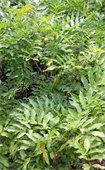 Photo Credit: J. Scott Peterson, USDA NRCS PLANTS Database |
|
|
 Photo Credit: David J. Moorhead, University of Georgia, Budwood |
|
|
|
Wisteria strangles and covers surrounding vegetation. As it grows up host trees, it winds tightly and girdles them by cutting through the bark and severing the vascular tissue, ultimately killing the tree. Vines that grow along the ground form dense thickets that readily shade out and smother native vegetation. Both invasive species of Wisteria can be controlled with the same methods. Cutting vines near the bases of trees (or as close to the ground as possible when treating vines that are not climbing a structure) and treating them with a systemic herbicide like glyphosate or triclopyr works to kill the roots. The vines above the cut will eventually dry out and die-don’t attempt to pull down vines that are outside of your reach. Be sure to apply the herbicide directly to cut stump within 5 minutes of cutting. Wisteria plants can re-sprout multiple times after cutting, so diligent follow-up treatments will be required. It’s best to treat wisteria before it begins producing seeds. |
|
|
|
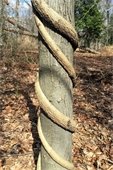 Photo Credit: Michael Ellis, MNCPPC |
|
|
 Photo Credit: Rebekah D. Wallace, University of Georgia, Budwood |
|
|
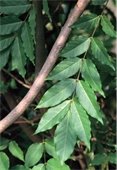 Photo Credit: James H. Miller, USDA Forest Service, Bugwood |
|
|
|
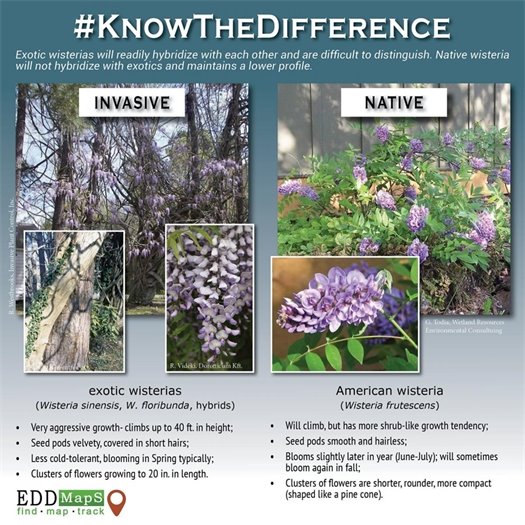
There is a native Wisteria, American wisteria (Wisteria frutescens), and it can easily be mistaken for Chinese or Japanese wisteria if you are unsure how to identify these species. Some helpful tips for telling the American species apart from the Asian varieties are that the Asian varieties bloom in the spring (April/May); American wisteria tends to bloom in June and July. American wisteria flowers are also more densely clustered together (like a pinecone) in comparison to the long, looser pendulum of flowers seen in Asian varieties. The seed pods of American wisteria are smooth and hairless as opposed to the pods of Asian wisteria which are velvety and hairy. The leaf tips of American wisteria tend to be blunt. Chinese and Japanese wisteria may be lovely, but their rapid spread poses a real threat to native plants and trees. By learning how to identify and manage these vines, we can help protect our landscapes from being overrun. If you spot wisteria growing unchecked in your yard, consider taking action to keep it from spreading—it’s a small step that makes a big difference! |
|
|
|
|
|
|
|
WANTED: Your Input about a Potential Bradford Pear Bounty Program UGA Sustainability Certificate Capstone Students have been working with The Sustainability Department to design a potential Invasive Species bounty Pilot Project here in Athens-Clarke County. As part of this planning process, we want your feedback! Click here to be taken to a quick 5-minute survey! |
|
|
|
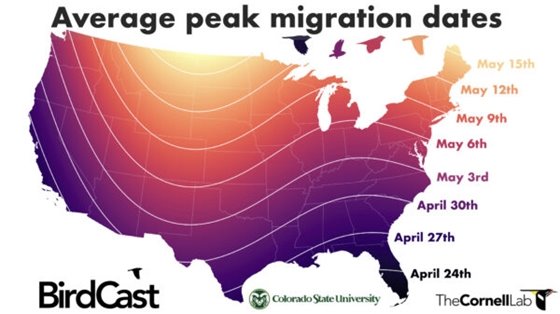
Tips for a Greener Lifestyle!In this series we explore how we can be sustainable together, right here in Athens-Clarke County! This Month's Topic:The Magic of MigrationStephanie Green What were you doing on the night of April 25, 2024? If you were a Cape May Warbler, you might have been flying at about 20 mph looking down on Athens from 2,000 ft. On that night last year, an estimated 914,400 birds winged their way over Clarke County while you slept. They were one nights' worth of the over 17,200,000 birds that crossed over us on their way North last spring (check out Birdcast for statistics). More than half of our North American bird species are migratory. That means they breed in one location and then spend the remainder of the year in another place -often thousands of miles away. Birds migrate in response to availability and timing of resources, especially food and nesting habitat. In the Northern Hemisphere birds move north following the budding trees and flowers and the flush of insects that go along with increased daylight and warming temperatures. They take advantage of plentiful food and shelter over the summer to raise their babies and then when fall comes, they head back south where resources are plentiful during winter. |
|
|
|
|
|
While there are some notable exceptions (Ruby-throated hummingbirds and Raptors), most birds migrate at night. This allows them to take advantage of more stable atmosphere and smoother flight conditions, as well as fewer predators. Nocturnal travel also means stars and the moon can serve as navigational aids. Migration is risky business. Not only do birds face natural hazards such as predation, exhaustion, and unpredictable spring weather, they also have to navigate increasing amounts of light pollution, the risks of colliding with buildings, and habitat loss. As we fly toward peak spring migration here in Athens (April 21st-May 10th, generally), here are some ways to help our feathered sojourners complete their travels: 1). Turn off or dim all non-essential lights between 11 pm and 6am.Light pollution can disorient birds, causing them to be drawn off course and placed at higher risk of colliding with buildings. 2). Keep your cats indoors.Outdoor cats kill millions of birds and small mammals every year. Hunting might be a natural instinct for them, but they aren’t native predators here in Georgia. 3). Go native in your yard.Gardening and landscaping with native plants provides healthy habitat for migrating birds to use as resting and refueling stops. Native trees are especially important shelter and food sources for birds. 4). Step away from the bug spray and other pesticides!Those bugs are gourmet bird food and we all know good food can make or break a road-trip! What about that Cape May warbler that might have flown over your house last April? He’s finishing up his winter stay in the Caribbean, enjoying the tropical flowers and insects. In a few weeks, he might flyover again on his way to a spruce-fir forest somewhere in Canada. But if you are lucky and he decides to make a pit-stop, you could catch a glimpse of him feeding in the tree tops of your favorite Athens park one morning in late April. Want to try spying on some spring migrants this year, but now sure where to start? The Oconee Rivers Audubon Chapter leads Bird Walks throughout April and May. Check out their schedule here! Need to stock up your bird buffet with some native plants, shrubs and trees? There are several plant sales happening in April and May that will have plenty of native choices. Check out our events section to see which one might work best for your gardening schedule. For sources and to learn more about migration click here! |
|
|
|
UPCOMING EVENTS:****************************************************************************************************** The Green Life Awards Ceremony Wednesday April 23rd 6:00 p.m.Georgia Botanical Garden, The Conservatory2450 S. Milledge Avenue, Athens GA 30605
Join us in an awards ceremony to recognizing leaders in sustainability in our community, selected by participating organizations. Learn more here! |
|
|
|
****************************************************************************************************** Athens Through Our Eyes2025 Green Life Art Exhibition on display the month of AprilLyndon House Arts Center 211 Hoyt St, Athens GA 30601
Come out to see PK-12 sustainability and nature themed art submissions that were selected for this year’s Green Life Art Exhibition: Athens Through Our Eyes. |
|
|
|
****************************************************************************************************** University of Georgia Earth Day Fair & MarketWednesday April 23rd, 12:00 pm - 3:00 pmUGA TATE PLAZA, 45 Baxter St. Athens GA 30602
ACCGov Sustainability will be tabling! Come out to see us! |
|
|
|
****************************************************************************************************** Join us for a Cleanup Project at Aguar Plaza!Earth Day April 22nd 2025
Volunteering will consist of cleaning stone signs, collecting litter, cleaning pathways, removing vegetation, and more. Athens-Clarke County Trails and Open Space and Sustainability Department will provide all necessary tools. Sign up here! Bring your enthusiasm and put in some elbow grease! Volunteers can park at the East Broad Dudley Park lot for easy access. |
|
|
|
****************************************************************************************************** Southern Sustainability Institute is holding a5-week Study Group on theAthens-Clarke County Clean & Renewable Energy PlanACC want to... - achieve 100% clean and renewable electricity for all municipal properties, government operations, and community-wide buildings by 2035
- power our community's electricity needs with 100% clean and renewable sources by 2050
Join us Tuesdays March 18, 2025 - April 15, 2025Each week (1.5 hour meeting) we'll read key sections of the plan, then discuss and brainstorm innovative ways that we, as citizens, can actively support, advocate, and contribute to reaching the ambitious yet crucial goals of this plan TWO SESSIONS Options:Southern Sustainability Institute: https://southernsustainabilityinstitute.org/  |
|
|
|
****************************************************************************************************** Athens-Clarke County Library Solar Dedication: You're Invited!SPLOST 2020 Project #11April 2, 2025 3:30 PMAthens-Clarke County Library (2025 Baxter St. Athens, GA)
Dedication will take place in the library parking area (or inside in the case of inclement weather). Light refreshments will be served. For questions or more information please contact ACCGov Sustainability at sustainability@accgov.com. |
|
|
|
****************************************************************************************************** The State Botanical Gardens Spring Plant Sale:State Botanical Garden Horticulture ComplexApril 17th 2:00 pm - 6:00 pm April 19th 8:00 am - 2:00 pm |
|
|
|
****************************************************************************************************** Athens East Piedmont Native Plant Society Native Plant Sale:Sunrise Nursey May 3rd 10:00 am - 2:00 pm |
|
|
|
****************************************************************************************************** Are you a Member of a Tax-Exempt Organization?- Social Groups
- Cultural Groups
- Religious Organizations
- Non-Profits
- (Tax Exempt) Private Schools
Your Organization May Qualify for Elective Pay!Elective pay is a federal tax program which allows tax-exempt organizations to receive a sizable credit for the installation of: - Solar Panels
- Batteries
- Electric Vehicles
- Electric Vehicle Charging Stations
- Ground Source Heat Pumps
Athens-Clarke County Sustainability Department will be hosting a presentation with the Georgia Environmental Finance Authority and the Southeast Energy Efficiency Alliance, discussing how local non-taxable entities can take advantage of Elective Pay. Event Details: Wednesday April 2nd 9:30 am to 11:30 am If your organization has pursued any of these projects in the past year or may consider such projects in the future: Please direct a representative of such organization to email the ACCGov Sustainability Department for further details and RSVP link! |
|
|
|
****************************************************************************************************** Putting Energy into Greener Spaces Athens-Clarke County Sustainability Department www.accgov.com/green 706-613-3838 |
|
|
|
|
|


 Share on Facebook
 Share on Twitter
 Share via Email
