|
|
Welcome to out Monthly Newsletter!Welcome to the ninth issue of our monthly newsletter and our first issue of 2025! We are thrilled be able to share what we are doing at the Athens-Clarke County Sustainability Department with you. Join us each month as we explore all things sustainability and how you can get involved! In this newsletter you will find: Latest projects, free resources, and upcoming events! |
|
|
|
ACCGov’s Newest Addition!Sustainability Department welcomes new team member!Joey Crews, Energy Program and Conservation Coordinator
|
|
|
|
Joey is passionate about sustainable energy solutions and environmental conservation. A recent graduate of Appalachian State University, Joey earned both his Bachelor’s and Master’s in Appropriate Technology. During his time at App State, Joey served as chair of the university’s Renewable Energy Initiative, led the university’s Solar District Cup team to a division championship, and contributed to the Town of Boone North Carolina’s Sustainability Committee. His dedication to service earned him a nomination for the Graduate School Outstanding Service Award. Joey brings experience in energy data analytics and local government solar management to Athens-Clarke County. As the Energy Program and Conservation Coordinator, Joey is excited to advance energy conservation strategies and programs that make measurable impacts on both the Athens’ community and the environment. When he’s not working to make the world more sustainable, Joey can be found on the basketball court or hanging out with his dog, Basil, who’s always ready for an adventure!
|
|
|
|
Starting the New Year Right!Measuring Outcomes and planning for ProgressAthens-Clarke County Unified Government is committed to obtaining 100% of its energy needs from clean and renewable sources by 2035. As part of this commitment, ACCGov is installing solar at government buildings, transitioning their fleet from internal combustion vehicles to electric and installing accompanying electric vehicle (EV) chargers. PERCENT OF LIGHT DUTY FLEET VEHICLES THAT ARE HYBRID OR FULLY ELECTRIC- FY 23: 19%
- FY 24: 26%
- FY 25: 28%
- FY 26: 36%
# OF FLEET EV CHARGERS- FY 23: 4
- FY 24: 28
- FY 25: 40
- FY 26: 60
ACCGov operates on a July to June Fiscal Year (FY). We are currently in FY25 (from July 2024 to June 2025). The FY 25 data for both EV chargers and EVs is calculated based on mid-year numbers plus all anticipated projects for the rest of the fiscal year. FY 26 data predictions are based on already allocated local funding. 2025 SOLAR PROJECTS- Main Library
- Costa Building
- Memorial Park
FUTURE SOLAR PROJECTS- East Side Library
- Advantage Behavior Health
ACCGov has three solar installations planned to be completed by the end of FY 25. These projects are at the Main Library, the remodeled Costa Building and at Quinn Hall located at Memorial Park. Post FY 25, solar is planned to be installed at the newly planned East Side Library and Advantage Behavioral Health building. This year ACCGov will also be implementing a new energy management software which will drastically improve energy tracking and conservation efforts. |
|
|
|
Join us for National Invasive Species Awareness Week!Imir Robinson Mark your calendars! National Invasive Species Awareness Week (NISAW) is February 24th–28th, and it's our chance to shine a spotlight on the impact of non-native species in our communities. Invasive species can wreak havoc on local ecosystems—outcompeting native plants and animals, disrupting habitats, and even introducing new diseases. This leads to biodiversity loss and long-term environmental and economic consequences. Led by the North American Invasive Species Management Association (NAISMA), NISAW unites communities, experts, and organizations to spread awareness and promote action. By working together, we can prevent the spread of invasive species, manage existing infestations, and restore affected habitats. Want to get involved here in Athens-Clarke County? There are lots of ways to take part, whether it’s removing invasive plants on your property, attending an event, or simply learning more! Check out ‘Upcoming Events’ at the end of the newsletter for local activities or review previous Invasive Species of the Month by clicking on those species names listed below or check out our website for more easy ways to help protect Athens-Clarke County’s natural spaces. September: JAPANESE CHAFF FLOWER October: ENGLISH IVY November: TREE-OF-HEAVEN & SPOTTED LANTERNFLY December: AUTUMN OLIVE Did you know some of the plants growing in our backyards could be harming local ecosystems? Leatherleaf Mahonia (Mahonia bealei) and Heavenly Bamboo, also known as Nandina (Nandina domestica), may look pretty, but these ornamental plants have spread beyond gardens and into our natural areas. Keep reading to learn about these plants in a two for one invasive of the month and join us next month as we contine to spotlight other common invasives. JAPANESE CHAFF FLOWER |
|
|
|
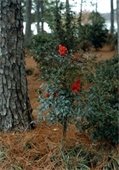 Photo Credit: John Ruter, University of Georgia, Bugwood |
|
|
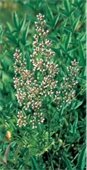 Photo Credit: James H. Miller, USDA FOOD SERVICE, Bugwood |
|
|
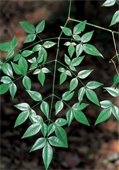 Photo credit: James H. Miller, USDA FOOD SERVICE, Bugwood |
|
|
|
Sacred BambooA Beautiful but Harmful PlantImir Robinson Sacred Bamboo (Nandina domestica), native to eastern Asia, has been a popular ornamental plant in U.S. gardens since the early 1800s. With striking bamboo-like foliage that turns crimson in the fall and vibrant red berries, it’s easy to see why it was embraced as a landscaping favorite. However, beneath the ornamental charm, Nandina has become a highly invasive species—especially in the southeastern U.S., where it threatens local ecosystems and wildlife. Nandina can quickly escape yards and gardens and spread into the wild, thriving in both sunny areas and shaded forest edges. It can grow up to 8 feet tall and produces clusters of bright red berries from September to April, which attract birds that spread the seeds far and wide. In addition to seed dispersal, Nandina also spreads through underground rhizomes, sending out new shoots and forming dense thickets. These dense patches block sunlight, choke out native plants, and disrupt entire ecosystems, making it a major threat to local biodiversity. One of the most alarming aspects of Sacred Bamboo is its toxicity. While the red berries are attractive, they are poisonous to humans, pets, birds and other wildlife species, adding another layer of danger to this invasive plant. If you have Sacred Bamboo in your yard, it’s important to prevent its spread. For removal, smaller plants can be pulled by hand when the soil is moist. The red berries should be cut, bagged and disposed of properly. Larger plants require digging up the entire root system, including the underground rhizomes, to prevent regrowth. If using herbicide, cut the stem as close to the ground as possible and immediately treat the stump with a high-concentration glyphosate solution. Herbicide treatment is most effective in late summer or early fall. By removing Sacred Bamboo from your yard and choosing native plants, you can help protect our local ecosystems and your feathered friends! |
|
|
|
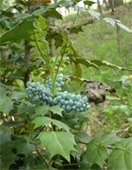 Photo Credit: Nancy Loewenstein, Auburn University, Budwood |
|
|
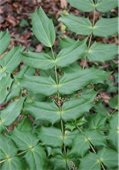 Photo Credit: Robert Vidéki, Doronicum Kft, Bugwood |
|
|
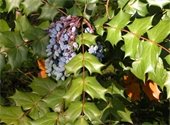 Photo Credit: Nancy Loewenstein, Auburn University, Bugwood |
|
|
|
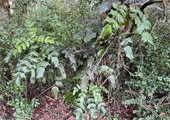 Photo Credit: Gary Whiting, Bugwood
|
Leatherleaf MahoniaAn Invasive to KnowChristian Snead Originally from China, Leatherleaf Mahonia (Mahonia bealei) was introduced as an ornamental plant in the 1800s. While valued for its unique evergreen foliage and winter blooms, this shrub has spread across southeastern forests, outcompeting native species. It’s now considered invasive in Georgia, Alabama, the Carolinas, Tennessee, Maryland, and Virginia. Leatherleaf Mahonia can grow in deep shade and form dense thickets, reaching between five and ten feet tall. Its stiff, spiny leaflets resemble holly leaves and grow in a feather-like pattern along the stem, with a single, larger leaflet at the tip. In late winter, the plant produces fragrant yellow flowers, followed by grape-like clusters of bluish-black berries. Birds and other wildlife consume these berries, spreading Mahonia’s seeds far and wide. In addition to seed dispersal, the plant spreads by sending up new shoots from its base.
|
|
|
|
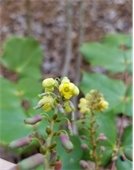 Photo Credit: Rebekah D. Wallace, University of Georgia, Bugwood |
Removing Leatherleaf Mahonia can be a challenge, but persistence pays off. Because of its sharp leaves, gloves and protective clothing are recommended. The most effective method is cutting the stem as close to the ground as possible—ideally within an inch—and immediately treating the stump with a high-concentration glyphosate herbicide. For those wishing to avoid herbicides, repeated cutting of new growth will eventually weaken and kill the plant, though it may take multiple treatments. If possible, uprooting the entire plant, including its deep taproot, is the best way to ensure it doesn’t grow back. Every Mahonia removed helps protect our local ecosystems. If you’re tackling this invasive species in your yard and looking for native alternatives, try wax myrtle, American holly or American beautyberry. For sources and to learn more click here!
|
|
|
|
Tips for a Greener Lifestyle!In this series we explore how we can be sustainable together, right here in Athens-Clarke County! This Month's Topic:Love’s Not a Limited Resource!Hannah Chaffee Grocery stores have been full of heart shaped chocolate boxes, pink teddy bears and and an amalgamation of red hued balloons for weeks now, but the day is finally in sight: Valentines day. Love —and carbon emissions— are in the air, so whether you feel destined to be the single friend for life or are staring dreamily into your partner’s eyes as the waiter unsuccessfully tries to get your attention to ask for your order, Valentines day is a day to celebrate all kinds of love. So why not take the day to also celebrate your love for the environment. Because after all, nothing is more attractive than caring for the planet and all the people living on it. So here is a list of fun, environmentally friendly dates that you can do with your significant other, your friends or by yourself (because you deserve some me time after all)! - Take your crush to the farmers market and buy them (or yourself) some sustainably sourced flowers or vegetables!
- Dress to impress! Give some love to second second hand garments and head to your local thrift store!
- Take their breath away (or your own)-literally! Embark on a romantic bike ride down the greenway.
- Impress your date with your immense knowledge of the ecosystem (or willingness to learn) by taking them bird watching.
- Hit the library! There is nothing more enchanting than participating in circular economies.
- Want to give them butterflies? Spend the afternoon planting native pollinator friendly flowers. Or better yet, start your own backyard composting!
We know that most of these are more fun to do as a couple, so if no of these strike your fancy just remember that you don’t need two people to go hug a tree!
|
|
|
|
UPCOMING EVENTS:*********************************************************************************************** THE VINE THAT ATE THE SOUTHFriday February 28th 5:00 p.m. - 6:30 p.m.North Oconee River Greenway,Starting at Easley’s Mill Trailhead$8.00 for Residents and $10 for Non-Residents
Join Athens-Clarke County Leisure Services Trails and Open Space staff to uncover “The Vine That Ate the South,” Kudzu. This fast growing and wide spreading invasive plant is sure to be identifiable from any roadside. Learn the history of this invader of southern ecosystems and current kudzu management efforts. Be prepared for a short hike, getting your hands dirty in harvesting invasive species, and to leave with your own art piece crafted from kudzu. Attendees will meet at the Easley’s Mill Trailhead of the North Oconee River Greenway.
REGISTER THROUGH LEISURE SEVICES HERE! *********************************************************************************************** Athens Through Our Eyes2025 Green Life Art Exhibition
PK-12 Nature and Sustainability Art Exhibition: Create a painting, drawing, sculpture, poem or photograph showing Athens- Through Your Eyes Entries due Febuary 28, 2025 Visit accgov.com/GreenLife for rules and application ********************************************************************************************* Athens A Través Ojos.2025 Exposición de Arte- Green Life
PK-12 Exposición de Arte: Te animamos a crear una pintura, un dibujo, una escultara, tomar una foto o escribir un poema para demonstrar Athens - A Través Nuestros Ojos. La fecha límite para enviar tu arte es hasta el 28 de febrero de 2025 Vista accgov.com/GreenLife para conocer las reglas y la solicitud. ************************************************************************************************ Putting Energy into Greener Space Athens-Clarke County Sustainability Department www.accgov.com/green 706-613-3838 |
|
|
|
|
|


 Share on Facebook
 Share on Twitter
 Share via Email
