Athens-Clarke County Sustainability Department Newsletter December 2025 Issue 18
Click here for the standard format version of our newsletter. Or continue reading for the accessibility-enhanced version of the newsletter.

Welcome to our Monthly Newsletter!

Welcome to the eighteenth issue of our monthly newsletter! We are thrilled to be sharing what we are doing at the Athens-Clarke County Sustainability Department with you. Join us each month as we explore all things sustainability and how you can get involved!

In this newsletter you will find: Latest projects, free resources, and upcoming events!

Season's Greetings

As we wrap up this year, we want to take a moment to thank each and every one of you for the role you’ve played in supporting sustainability; whether through big initiatives or small everyday choices. There’s a quote we love that says, “We don’t need a handful of people doing sustainability perfectly; we need millions doing it imperfectly.” This idea is so important because sustainability can sometimes feel overwhelming, like there’s too much to tackle and never enough progress. But every action matters. Every small change adds up to something bigger. So let’s celebrate the steps we’ve taken together and keep focusing on what we can do, because those efforts truly make a difference. From all of us in the Sustainability Department, we wish you and your loved ones a joyful holiday season. Big things are coming in 2026, and we can’t wait to share them with you!

Invasive Species

of the Month:

Sacred Bamboo

By Imir Robinson

Sacred Bamboo

Photo Credit: James H. Miller, USDA Forest Service, Bugwood.org

Nandina domestica, also known as heavenly bamboo or simply nandina, has long been admired for its ornamental beauty. Native to eastern Asia—including China, Japan, and India—this evergreen shrub was introduced to the United States in the early 1800s and quickly became a favorite in American landscapes. Its dark green bamboo-like foliage, which can turn a striking crimson in winter, and its clusters of bright red berries make it a visually appealing choice for gardens and decorative plantings.

However, beneath its decorative charm lies a serious ecological threat. In the southeastern United States, nandina has escaped cultivation and spread aggressively into natural areas. Its ability to thrive in a wide range of conditions—from shaded forest edges to full sun—has allowed it to establish itself rapidly. Once rooted, it can grow up to eight feet tall and spread through underground rhizomes, forming dense thickets that crowd out native vegetation. These thickets block sunlight and monopolize soil nutrients, disrupting ecosystems and threatening biodiversity.

While some homeowners plant nandina to provide winter food for birds, the berries pose a hidden danger. They contain cyanogenic compounds, which break down into cyanide when ingested. This makes them toxic to many birds, pets, and even humans. One species particularly at risk is the Cedar Waxwing. These birds migrate south in the winter and feed in large flocks, often consuming berries in great quantities. In 2009, the University of Georgia’s Veterinary Medical School documented a mass poisoning of Cedar Waxwings after they consumed nandina berries. The full report is available through UGA’s website at vet.uga.edu.

To protect local ecosystems and wildlife, it’s best to avoid planting nandina altogether and instead choose native alternatives such as winterberry or deciduous holly. For those who already have heavenly bamboo in their gardens, removal is strongly recommended. Small plants can be pulled by hand, while larger ones may require digging to ensure all rhizomes are removed. If herbicide is used, it should be applied directly to the stump immediately after cutting for the most effective results. Timing is also important—removal should ideally occur before the plant produces berries to prevent seed dispersal and reduce the risk to wildlife. If full removal isn’t possible, cutting off flowers or removing berry clusters before they ripen can help limit the plant’s spread.

During the holiday season, nandina berries are often used in wreaths and garlands. While they may add festive color, they should never be composted at home, as typical compost piles do not reach the high temperatures needed to destroy the seeds. Fortunately, Athens-Clarke County offers a commercial composting program through the ACC Solid Waste Department. Their high-heat composting process renders the seeds non-viable, making it a safe disposal option. Berries can be dropped off at any of the ACC compost program locations. If that’s not an option, the berries should be disposed of in the trash to prevent accidental spreading.

By staying informed and taking proactive steps, we can help protect Georgia’s native habitats from the spread of invasive species like nandina—and preserve the health of our ecosystems for generations to come.

For sources, click here!
Tips for a greener lifestyle

This Month's Topic:

Sustainable Holidays

By Riley James


The holidays are a feast for the senses – and sometimes for the landfill. Between the twinkly lights, the glittery wrapping paper, and the sudden urge to buy a 12-foot inflatable snowman, it’s easy to forget that all this cheer comes with a carbon footprint.
But good news: you don’t have to sacrifice the sparkle to keep things sustainable. With a few creative swaps, you can celebrate the season and show the planet a little love.

Deck the Halls (Not the Landfill)

  • Skip the plastic tinsel and go for natural, compostable décor. Think:
  • Dried orange slices (bonus: your house will smell amazing)
  • Salt dough ornaments (a classic for a reason)
  • Garlands made from pine, magnolia, or even popcorn
  • Pine cones (free, festive, and squirrel-approved)
  • Paper crafts — from snowflakes to stars, paper is endlessly versatile and recyclable.

Reduce, Reuse, Re-wrap
Most shiny wrapping paper isn’t recyclable — but your creativity is. Swap the wrapping paper with brown packaging paper, old newspaper, etc. Reuse some of those old bows and ribbons from last year. Bring some of the outdoor foliage indoors to make your presents extra special. Try out Furoshiki, the Japanese art of fabric wrapping.

The Great Tree Debate

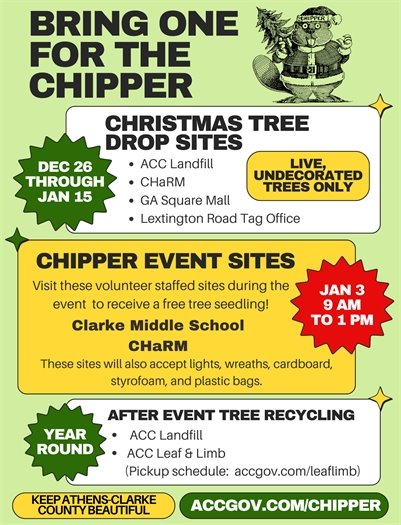
Real or fake? The answer is: it depends. A real tree from a local farm is often the greener choice; especially if you recycle it after the holidays. (Athens folks, check out Bring One for the Chipper.)
If you already have a plastic tree, keep using it! The key is longevity. According to a study by WAP Sustainability, it can take longer than 10 years of reuse to offset the environmental cost of production. In another study done by ellipsos, it can take almost 20!
And if you’re feeling adventurous? Some places even let you rent a living tree.


The Eco Shelf

Small is Beautiful

By EF Schumacher


First published in 1973, Small is Beautiful: Economics as if People Mattered by E.F. Schumacher remains a quietly radical book that challenges the very foundations of modern economic thinking. Schumacher, a British economist, argues that the relentless pursuit of growth, industrial scale, and technological dominance often comes at the expense of human well-being and ecological balance. Instead, he proposes a more human-centered, sustainable approach to economics - one that values simplicity, community, and the responsible use of resources.

What makes Small is Beautiful so compelling today is how prescient it was. Long before climate change became a global concern, Schumacher warned of the dangers of overconsumption and environmental degradation. His advocacy for “appropriate technology” and local economies resonates deeply in an era grappling with the consequences of globalization and ecological crisis. The book invites readers to rethink what progress really means and to consider whether bigger is always better. Or if, perhaps, smaller, more mindful systems might offer a more sustainable future.

Reading Small is Beautiful isn’t just an intellectual exercise - it’s a call to action. It challenges us to imagine a world where economics serves people and the planet, not the other way around. For anyone interested in sustainability, ethical living, or reimagining the future, Schumacher’s ideas are not only relevant, but they’re essential.

Recommended by Joey Crews

Upcoming Events:

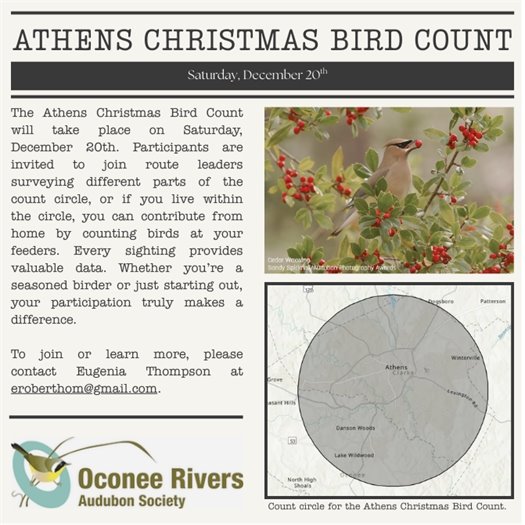
Athens Christmas Bird Count
Bring One For the Chipper

Putting Energy Into Greener Spaces


Athens-Clarke County Sustainability Department
www.accgov.com/green
706-613-3838

Copyright 2024 - Athens-Clarke County Unified Government (ACCGov)
Athens-Clarke County Unified Government | P.O. Box 1868 | Athens, GA 30603

Powered by
CivicSend - A product of CivicPlus