Issue #6 October 2024 Athens-Clarke County Sustainability Department Newsletter
Click here for the standard format version of our newsletter or continue reading for the accessibility-enhanced version of our newsletter

Welcome to our Monthly Newsletter!

Welcome to the sixth issue of our monthly newsletter! We are thrilled be able to share what we are doing at the Athens-Clarke County Sustainability Department with you. Join us each month as we explore all things sustainability and how you can get involved!

In this newsletter you will find: Latest projects, free resources, and upcoming events!

Tips for a Greener Lifestyle!

In this series we explore how we can be sustainable together, right here in Athens-Clarke County! 

This Month's Topic: 

Buying Local in Every Season

Hannah Chaffee

        Athens is blessed with a thriving community of entrepreneurs. A great way to enjoy the weather and support local businesses is by visiting Athens’ various markets. Whether you’re looking to snag an early gift for your impossible to shop for family member or simply getting some ingredients for that recipe you’ve been dying to try, buying local —when you can— is a great way to live more sustainably!

        Small local businesses don’t have to transport their goods long distances, significantly reducing the emissions associated with their products. When it comes specifically to agriculture, this often means that available produce is seasonal. Right now, apples, sweet potatoes, winter squash are in season along with many leafy greens and cruciferous vegetables.

        The more connected you can be with the supply chains that provide you with goods and services, the better. A large part of being an ethical consumer is educating yourself about a businesses’ environmental and social standards. Buying local gives you the opportunity to ask sellers how a product gets into your hands and who helped along the way. Often, local entrepreneurs are excited to share the steps they are taking to be more sustainable. 

Make an effort to patron minority owned businesses! Your support grows opportunity for disadvantaged communities.

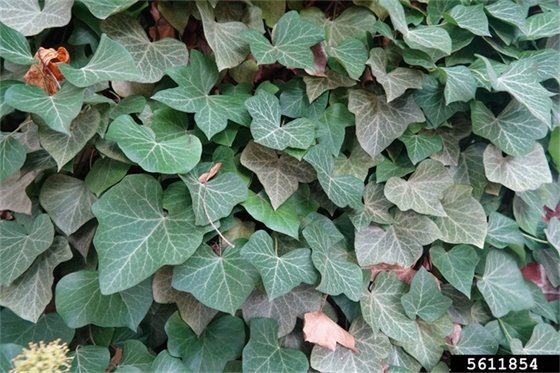
English ivy wall

Photo credits: Rebekah D. Wallace, Bugwood

Invasive of the Month:

English Ivy

Christian Snead

Join us each month in this new series as we learn about different invasive species!

        English ivy (Hedera helix L.) is a Category I invasive species in the state of Georgia, meaning that it poses a serious threat to native habitat. English ivy is an evergreen perennial climbing vine that attaches to tree bark, brickwork, and other surfaces by excreting a glue-like substance that helps it stick and stay in place. 

       It is native to Europe, Scandinavia, and Russia, having first been introduced to the United States in 1727. It continues to be sold as an ornamental plant despite its threat to natural ecosystems, parks, landscapes and other green areas. You can find English ivy in 28 different states, including Hawaii.

       English ivy thrives in shady to full-sun conditions, and prefers moist soil. It doesn’t tolerate drought or salinity well. The vines grow outwards, ranging in length from anywhere between 3 to 50 feet, dependent on how tall its supporting structure is. 
English ivy climbing tree

Photo credits: Rebekah D. Wallace, Bugwood

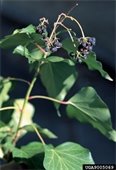
English Ivy flower

Photo credits: Rebekah D. Wallace, Bugwood

English Ivy Fruit

Photo credits: Rebekah D. Wallace, Bugwood

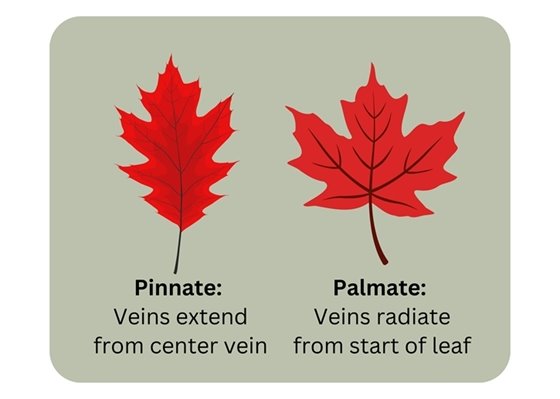
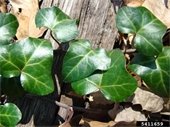
       English ivy has two growing stages: juvenile, and mature. The plant is considered juvenile in its first year of growth, featuring palmate leaves with 3-5 lobes. However, when the plant is flowering in its mature stage, you can find different variations of its leaves along the vine. Primarily, leaves at this stage are dark green with whitish veins with a waxy cuticle (outer coating of the leaf).

Pinnate: Leaf veins extend from the center vein while Palmate: Veins radiate from the start of the leaf
Close up on English Ivy leaves

Photo credits: Rebekah D. Wallace, Bugwood

        English Ivy doesn’t bloom until it’s reached its adult stage, producing a starburst cluster of small, greenish-yellow flowers in late summer to early fall. Its fruits are small, black, and have a fleshy outer later with stone-like seeds in the center. Birds eat these fruits and disperse the seeds to new areas, assisting its spread. 

    A common misconception is that English Ivy is a good ground cover, but in reality, it does not sport a very robust or extensive root system, failing to prevent erosion particularly on steeper slopes.

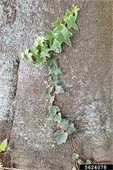
English Ivy growing on tree close up

Photo credits: Rebekah D. Wallace, Bugwood

        In the United States, there aren’t any natural pests or diseases that affect English ivy, and there are many places across the country that have been labeled “Ivy Deserts” because the ivy has completely choked out other plants, decreasing bug diversity, which subsequently decreases bird populations as well. Areas that are heavily afflicted by large mats of English ivy on the ground retain moisture which can create breeding grounds for mosquitos.

       Removal of English ivy is straightforward, but can be time consuming and tedious. The first step is to remove the climbing vines; severing the stem will cause the plant growing above that line to die, allowing you to focus on the removal of everything below. Roots can be pulled up by hand and disposed of by being left to dry out and die or by being thrown in the trash. When using herbicide, it’s more efficient to focus on newer growth, as older leaves are more robust and resistant to chemical treatment. 

For sources and to learn more click here!

The Future is Bright —And Colorful

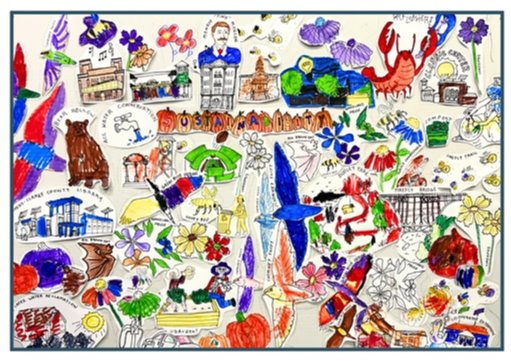
        Athens-Clarke County Sustainability Department hosted a booth at the 3rd Annual Athens-Clarke County Sheriff’s Office’s Fall Festival. The event was well attended by many celebrities including numerous princesses and notable superheroes, along with the more traditional crowd of vampires, dinosaurs and zombies. 

        All of whom helped the ACC Sustainability staff color in what a sustainable future in Athens can look like: filled with native species, powered by renewable energy, and most importantly —built together!

"You guys are doing great!" - Local Spiderman to Sustainability Staff

Check out our collage below!

Collage of numerous Sustainability and Athens-Clarke County related things colored in by children

Collage from Fall Festival

Putting Energy into Greener Space

Athens-Clarke County Sustainability Department

www.accgov.com/green

706-613-3838

Share on Facebook
Share on Twitter
Share via Email

Copyright 2024 - Athens-Clarke County Unified Government (ACCGov)
Athens-Clarke County Unified Government | P.O. Box 1868 | Athens, GA 30603

Powered by
CivicSend - A product of CivicPlus